Showing posts with label Forensic Science Daily. Show all posts

Tuesday, May 29, 2012

DID YOU KNOW?


1.      The polymerase chain reaction (PCR) was featured in the motion picture Jurassic Park.
  In this story, scientists find fossilized blood-sucking insects. These insects, which had bitten dinosaurs, were caught in tree sap that fossilized into amber.
           The scientists in the film extracted dinosaur blood from the fossilized insects and used the    DNA in the blood to recreate dinosaurs through cloning.
2.      When a human egg and sperm combine, nearly a billion different gene combinations are possible.

3.      New Zealand is the world leader in forensic palynology and in the acceptance of pollen and spore evidence in court cases. Palynological evidence is underutilized in many parts of the world, including the United States.

4.      Pollen grains can be extracted safely from rocks that are millions of years old. This is a valuable characteristic not only for palynologists, but also for oil companies and archaeologists.

BLAST ALONG MOI AVENUE


Breaking News…
At around 1.15pm on 28th of May 2012, there was a loud blast along Moi Avenue on a building adjacent to MKU towers. The building houses various stores and customers were busy doing their shopping when the incident occurred.
 The cause of the blast apparently has not yet been confirmed but the speculations about a possible electricity failure has been ruled out by the KPLC officials at the scene stating that the nature of the blast amounts to something more than an electrical fault.
The Kenya Prime Minister Hon. Raila Odinga who arrived at the scene spoke about acts of terrorism and bravely stated that the nation will not be intimidated by the terrorist’s effort to destroy the nation. Prime ministers words seemed to bear a lot of weight as he stated that the blast has all the characteristics of acts of terrorism as seen from all over the world.
On the other hand, police commissioner who was also at the scene was quick to state that we should not be quick to state the cause and said he doesn’t see a possibility of an act of terrorism. He however added that that the experts were on their way and investigations are to be started to establish the real cause of the blast.
Another word from the minister of internal security prof George saitoti, said he had no doubt that this and other grenade attacks are part of tactics that the al shaabab are using to intimidate rather hit back at the nation.
Victims from the blast have been rushed to Kenyatta National Hospital where they are receiving treatment and it is said that 35 people have been injured.
And my question is to the forensic experts especially the students in the university. Can you write a detailed report on crime scene investigation procedures stating all the necessary equipment’s and tools to be used?

AN INSIGHT TO FORENSIC SCIENCE DISCIPLINES


Forensic science is used to help solve crimes and there are many types of forensic methods/ disciplines.
1.     Forensic toxicology- refers to the use of toxicology to determine what chemicals are present in the body after earth.
2.     Forensic psychology- deals with the study of various human behaviors.
3.     Criminalistics- is the application of sciences to situations in an attempt to achieve answers. This is commonly used in the area of fingerprints, tire tracks, or foot impressions.
4.     Forensic DNA analysis- is used to determine the DNA sequence from biological samples.
5.     Forensic anthropology- the application of physical anthropology in a legal setting
6.     Cyber forensics- the gathering of digital data that is used in the court of law.
7.     Forensic engineering- the investigation of materials, products, structures or components that fail to operate or do not function as intended.
8.     Forensic entomology- the use of insects, and their arthropod relatives that inhabit decomposing remains to aid in legal investigations.
9.     Forensic odontology- the study of all dentition of all human beings
This is just but the tip of the iceberg in forensics, there are a whole lot of topics ranging from bugs to DNA and all branches are used in actual criminal investigation.
A comprehensive list on other forensic related disciplines is discussed on Fields of Forensic Science.
Crime scene investigators have special equipment that they use to investigate crime scenes. This equipment is packed into crime scene kits. They include 
Fingerprint powders designed to find fingerprint on surfaces, brushes, magnetic powder wands, and placards for making important forensic evidence, tape, scissors, tweezers, tape, pencils and pens.
Chemicals for detecting bodily fluids like luminal and black lights.
Bodily fluids can be the most valuable piece of evidence because it can yield DNA, the holy grail of proof.

FORENSIC SCIENCE DISCIPLINES


Forensic Pathology
Forensic pathology represents a subspecialty within the medical specialty of pathology dealing specifically with the investigation of sudden, unexpected, and/or violent deaths. The autopsy is central to the practice of forensic pathology.
Forensic Anthropology
Forensic anthropology is a subspecialty within the scientific field of physical anthropology (the study of human beings in relation to their physical character); in which forensic anthropologists examine skeletal remains (bones). Forensic anthropologists attempt to answer questions about bones, including questions regarding species of origin (human versus nonhuman), gender, age, race, stature, and nutritional status, existence of disease processes, and the presence and character of skeletal trauma. A forensic pathologist may consult with a forensic anthropologist when attempting to address any of the questions above. A frequent instance of consultation occurs when the forensic pathologist is presented with a badly decomposed or skeletonized corpse that is unidentified

Forensic Entomology

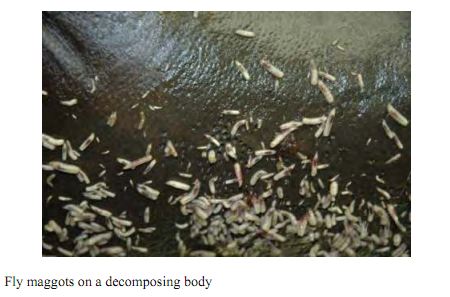
Forensic entomology is a subspecialty within the biological science discipline of entomology (the study of insects) that primarily deals with insect succession patterns in decomposing human bodies. Evaluation of insects (including larval stages, or maggots) found on decomposing bodies can permit scientific estimation of the time of death .In certain circumstances; information regarding the location of death may also be ascertained. Forensic pathologists do not consult with forensic entomologists in all decomposed cases, but will consult with them on select cases where estimating the time of death may be very important (for example, in homicides with decomposition and insect activity). 


Forensic toxicology is a discipline that involves the identification and quantification of drugs and other poisons or toxins in body tissues, including blood. “Screening tests” are said to be “qualitative,” where a test is either positive (indicating that the drug/toxin is present) or negative (indicating that the drug/toxin is not present).
When specific levels of drugs or toxins are determined, the tests are said to be “quantitative.” For a result to have forensic significance, two separate methodologies are required, an initial (screening) test, and a confirmatory (quantitative) test. Another function of some toxicology laboratories is drug identification. For example, if a bag of white powdery substance is found in the pocket of a dead person, the substance can be submitted to the laboratory for identification. Forensic pathologists rely a great deal on the forensic toxicology laboratory. In many jurisdictions, toxicology testing is performed on a majority of the autopsy cases. In a significant percentage of forensic autopsy cases, the cause of death is related to the toxicology results.
Forensic Psychiatry
Forensic psychiatry represents a discipline dealing with the evaluation of the mental state of criminals. Occasionally, forensic pathologists will interact with forensic psychiatrists and police investigators to form a “psychiatric profile” of a suspect in a particular murder or series of murders. A “psychological autopsy” is sometimes necessary when attempting to determine the state of mind of a suicide victim.

FORENSIC SCIENCE SALARIES


Income varies greatly depending on the degree, your actual job, where you work, and how many hours you work.
It’s said; you may never ‘get rich’ but will have a good income, satisfied with your job, knowing you are contributing to justice.
Forensic scientists work different hours depending on job description.
        I.            Working in the laboratory for almost 40 hours a week.
     II.            In the fields or digs
   III.            Others wait for calls and work after their regular shifts
In the USA, the salaries vary as shown below:
Department
Income in $
Crime lab analyst
16.75-21.44/hour
Crime scene analyst
31.87-36.49/hour
criminalists
5000-7000/month
Crime lab director
58,000-76,000/yr
DNA analyst
62,000-75,000/yr
Evidence custodian
86,000-144,000/yr
Firearms examiner
2,000-5,000/month
Fingerprint technician
30,000-46,000/yr
Forensic autopsy Assistant
24.04-29.08/hour
Forensic technician
4,000-5,000/month
Forensic biologist
46,000-64,000/yr
Forensic evidence technician
4,000-5,000/month
Forensic scientist
35,000-52,0000/yr
Law enforcement training officer
22.0-30.00/hour
Latent print examiner
108,000-158,000/yr
Latent print technician
33,000- 50,000/yr
Toxicologist
6000/month
Trace analyst
2,000-3,000/month


In Kenya, that is subject to a lot of influences and the best to say is to urge us to be patient and wait for that day. However, we could compare the salaries to what the present Crime scene 
investigators and police earn just to have a rough figure.

Friday, May 18, 2012

SUICIDE_ Causes and Solutions


SUICIDE_ Causes and Solutions

Nairobi woke up to the news of the death of Finance ministers son on Wednesday morning a shocking event that has since left the family at loss of their last born son.
Brian Karanga Njeru was a forth year student at the university of Nairobi taking computer science at Chiromo campus and was aged 26 years evidential of the youthful life gone too soon.
With the worlds report stating that over the past 60 years, overall rate of suicide among the adolescents has tripled making it the third leading cause of death among 15-25 year olds and the second leading cause of death among college students it is therefore necessary to take stringent measures to try and stop this from happening because I believe there are several other lives lost daily through a similar manner and not reported let alone highlighted on our televisions.
As once stated, a suicide attempt should never be taken lightly as this is indicative of a serious problem within the person and the environment at large and we all play a role in some way as human beings are interactive creatures.
Back to our sad story, police say the 26 year old  was found dangling from a rope after hanging himself and the body has since been taken to the mortuary _word from Nairobi deputy provincial police chief  Moses Nyakwama.
The family, through their spokesperson has however said they are yet to know the cause of death from the post mortem results yet to be announced.
In this article though, I am going to highlight some aspects related to suicide like noting the possible symptoms of suicidal person and how to possibly prevent death.
As a starting point, most people who commit suicide suffer from mental (bipolar disorder) or emotional disorders like depression. Studies show that suicide attempts among young people may be based on long standing problems triggered by a specific event and this should make each one of us alert to note any changes. This specifically addresses the parents who should take their time and get to know issues affecting their children at home, school and generally socially. Parents should be ready to offer counseling to their adolescents who are faced by numerous challenges at this stage of their life as suicidal adolescents may view a temporary situation as a permanent condition. This triggers feelings of anger and resentment combined with exaggerated guilt and can lead to impulsive, self-destructive acts.


It is therefore our responsibility to note key symptoms of a suicidal person which would include among many other things the following 10 signs and a point to note however, a person showing the symptoms doesn’t really mean they are suicidal.
1.      Verbal suicide threats  for instance use of words such as , “you are better off than me”, “maybe I won’t be around ”, ‘I think I have had too much of this’
2.       Expression of hopelessness and helplessness
3.      Previous suicide attempts
4.      Depression
5.      Lack of interest in future plans
6.      Daring or risk taking activities
7.      Giving away priced possessions
8.      Personality changes. Dramatic changes in personality or appearance can be very evident.
9.       A change in either eating or sleeping patterns or both.
10.  A severe drop in school performance
With such symptoms, one can clearly be able to move in and offer assistance in several ways and here are some of the ways you can offer help to suicidal teens.
1.      Offer help and listen- encourage depressed teens to talk about their feelings as you listen. Do not lecture them.
2.      Talk about suicide- as a parent, guardian, friend, teacher or relative, ask brief questions and do not be afraid of frank discussions. Remember, silence is deadly.
3.      Trust your instincts- if it seems that the situation is serious, seek urgent help. Do not speculate on what to do next. At this point talk to the teen and NEVER offer to keep secrets.
4.      Lastly, you can seek professional help- seek expert advice from a mental health professional or/and you can also alert key adults in the teens life including family, friends and even teachers.
To conclude this part, I send my humble condolences to the family of Hon. Dr. Njeru Githae. May his soul rest in peace.

In the next series of suicide, I will list all kinds of hanging,
 expert factors to consider in the case of hanging, collection of evidence from a suicide crime scene and how forensics plays a big role in the determining the cause of the death.